New rules of the game in copyright protection for designs: What did the Court of Justice change in the Mio and konektra cases?
On 4 December 2025 the Court of Justice of the European Union issued its judgment in the joined cases C-580/23 (Mio AB v Galleri Mikael & Thomas Asplund AB) and C-795/23 (USM U. Schärer Söhne AG v konektra GmbH). Following the judgments in C-683/17, Cofemel, and C-833/18, Brompton Bicycle, this is another major step in shaping a uniform standard across the EU for copyright protection of designs. The court clarified the methodology for assessing the originality of utilititarian objects, and also sought to resolve the relationship between protection of industrial designs and copyright protection, and to clarify the rules for evaluating infringement of copyrights to designs.
Earlier decisions by the Court of Justice on originality under copyright law
The dispute in C-683/17, Cofemel, before the Portuguese court involved clothing designs. The question referred for a preliminary ruling was whether copyright protection for a design could be conditioned on the design generating a “specific, aesthetically significant visual effect.” The Court of Justice said no, holding that the notion of a “work” under Art. 2(a) of Directive 2001/29/EC constitutes an autonomous concept of EU law and requires fulfilment of two conditions:
- Existence of an original subject matter, in the sense of being the author’s own intellectual creation (Cofemel, par. 29), and
- Existence of an expression of that creation which is identifiable with sufficient precision and objectivity (Cofemel, par. 32).
There the court rejected the possibility of conditioning the protection of the design of utilitarian objects on additional grounds, such as a particular degree of the design’s aesthetic or artistic value. At the same time, the court stressed that the mere fact that a design may generate an aesthetic effect does not necessarily mean that the design has originality for purposes of copyright law, particularly in the case of clothing designs (Cofemel, par. 54–55).
In turn, C-833/18, Brompton Bicycle, involved a folding bicycle whose shape greatly depended on functional demands. There the court elaborated on the line of precedent presented in Cofemel, recognising that even in the case of products whose form is dictated by technical considerations, copyright protection is not ruled out, as long as there is room for the author to reflect his or her personality as an expression of free and creative choices (Brompton Bicycle, par. 26–27). The key is thus not the nature of the object, but the scope of actual freedom of the designer shaping its form.
However, the court also stressed that the criterion of originality cannot be met by the components of an object which are differentiated only by their technical function, as copyright protection does not extend to ideas. Where the expression of those components is dictated by their technical function, “the idea and the expression become indissociable” (Brompton Bicycle, par. 27).
The Court of Justice also pointed out that in assessing originality, the referring court should take account of all the relevant aspects of the case, as they existed when the object was designed, irrespective of factors external or subsequent to the creation of the product, which are not relevant (Brompton Bicycle, par. 36–37).
Judgment in joined cases Mio and konektra (C-580/23 and C-795/23)
The joined cases C-580/23 and C-795/23 involved two separate disputes.
In Case C-580/23, the Swedish company Asplund (Galleri Mikael & Thomas Asplund AB), a furniture designer and manufacturer, accused the company Mio AB of infringing its copyright to its Palais Royal series of dining tables by marketing Mio’s Cord line of tables. Mio disputed the originality of Asplund’s tables, alleging that they were based on variations of previously known designs.
In Case C-795/23, the Swiss company USM U. Schärer Söhne AG (USM), manufacturer of the USM Haller modular furniture system, characterised by coloured panels and chrome pipes connected through ball-shaped nodes, alleged that the German company konektra GmbH, which sold replacement parts for the USM Haller system, also manufactured and sold its own furniture system identical to the USM system. The lower court (Landgericht Düsseldorf) upheld USM’s copyright claim, but on appeal, the Oberlandesgericht Düsseldorf denied the claim in a judgment from June 2022, finding that the USM Haller system did not meet the conditions for copyright protection under Cofemel and Brompton Bicycle.
Both cases reached the Court of Justice via references for a preliminary ruling, from the Swedish court of appeal (Svea hovrätt) and the German Federal Court of Justice (Bundesgerichtshof—BGH) respectively.
The judgment handed down by the Court of Justice in Mio and konektra includes several key findings confirming or elaborating on the earlier case law.
First, in response to the question referred by the German court, the Court of Justice held that “there is no relationship of rule and exception between design protection and copyright protection,” and thus in the case of useful products it is permissible to pursue protection under both grounds at the same time, so long as the conditions for each are met. Moreover, when assessing the originality of applied art, stricter requirements should not be applied than for other categories of works (Mio and konektra, par. 56–58).
Thus, once again, the Court of Justice rejected the notion that there is some gradation of value among artistic works for purposes of copyright protection. For example, such a concept, known as Stufentheorie, had been applied in the practice of the German courts, in a two-stage approach under which new, individual designs were subject to protection under the law of industrial designs, while to obtain copyright protection utilitarian objects also had to show an added “aesthetic achievement,” i.e. a distinct exceeding of the average level of design protected by the law of industrial designs. But that approach began to evolve toward a more liberal evaluation of the grounds of originality in the case of utilitarian objects, beginning with the ruling by the BGH in the Geburtstagszug (Birthday Train) case from 13 November 2013 (case no. I ZR 143/12).
Second, the Court of Justice clarified in a sense the methodology for assessing the originality of a work. It pointed out that under Directive 2001/29/EC, a “work” must reflect the “personality” of its author as an “expression of free and creative choices.” Nonetheless, the court stressed that the lack of copyright protection does not apply only to choices dictated by functional or technical limitations, which by definition cannot be regarded as free and creative. Nor is such protection warranted by choices that are objectively free but are not creative. The mere possibility of choosing, arising for example from the availability of numerous shapes, colours or forms, is not sufficient to show originality. It is necessary to show that the choices made by the designer “bear the imprint of the author’s personality” and give the object “a unique appearance” (Mio and konektra, par. 82).
Third, the Court of Justice expressly rejected the “overall impression” test for assessing copyright infringement, pointing out that this criterion applies instead to protection of industrial designs. To find a copyright infringement, it must be determined whether the creative elements of the protected work “have been reproduced in a recognisable manner” in the allegedly infringing item (Mio and konektra, par. 86). Consequently, the court also confirmed that the absence of the “same overall visual impression” between the compared utilitarian items is insufficient in itself to conclude that there is no copyright infringement.
Methodology for assessing originality—what must the rightholder show?
The Court of Justice pointed out that under copyright law, the creative nature of the choices made by the author cannot be presumed, for example because the work has won recognition in artistic circles (e.g. from being displayed in exhibitions or museums). A finding that a piece achieves an aesthetic or artistic effect, even when it clearly distinguishes the piece visually, is not sufficient. In considering the issue of originality, the national court “must seek out and identify the creative choices in the shape” of the object (Mio and konektra, par. 65).
Significantly, the national court may consider the author’s creative process and intentions, but it must find that these aspects are concretely expressed in the object itself. The author’s intentions as such lie within the sphere of unprotected ideas. Thus the court cannot definitively base its assessment on such evidence as a description of the creative process in which the author presents his or her intentions. Such evidence can certainly be helpful, but it is not decisive. As Advocate-General Maciej Szpunar aptly pointed out in his opinion in the joined cases, such evidence may simply not be available, and thus the court must be in a position to make its assessment of originality based on an analysis of the object itself (opinion, par. 47–50).
The Court of Justice also explored several specific issues.
First, “the author’s use of already available shapes does not, in itself, exclude originality. Indeed, subject matter composed solely of available shapes may be original where its author has expressed his or her creative choices in the arrangement of those shapes” (Mio and konektra, par. 78).
This view lines up with Art. 3 of the Polish Act on Copyright and Related Rights of 4 February 1994, under which collections and compilations, even if they contain unprotected materials, may themselves constitute a work, as long as their selection, arrangement or presentation has a creative character. In a recent judgment from 25 October 2024 (case no. I AGa 399/22), the Poznań Court of Appeal, citing among other things Art. 3 of the Polish act, held that a ladies’ handbag which is a compilation of familiar features and design solutions commonly used in making leather goods, may enjoy copyright protection if the juxtaposition bears the hallmarks of innovation and originality.
Second, the existence of similar or even identical forms created before the object sought to be protected as a work was made may be a relevant indicator in assessing the originality of the object (perhaps showing that it has little or no originality), but this does not automatically exclude a finding that the object is a copyrightable work. In particular, with respect to utilitarian items, where the maker’s creative freedom may be limited by technical, functional or normative factors, it cannot be ruled out a priori that different authors, operating independently, have made similar creative choices. Thus, the mere fact that similar solutions existed earlier does not necessarily mean that an object lacks originality.
Assessment of the infringement of copyright to a design
As mentioned, the Court of Justice expressly rejected the “overall impression” as the test for assessing infringement of copyright to a design. Previously, a comparison of the overall impression evoked by the conflicting objects played a key role in the assessment of infringements in the case law of some national courts (e.g. in Germany). The Court of Justice stressed that to find a copyright infringement, it must be found that:
- There was unauthorised use of original elements of a protected work, and
- Those elements were reproduced “in a recognisable manner” in the allegedly infringing item.
The court also stressed that the scope of copyright protection does not depend on the degree of creative freedom enjoyed by the author of the work. If the competing objects draw from the same earlier pattern or source of inspiration, only the creative elements which the author “added” to the common forerunner are subject to protection. And only the reproduction of these new elements in the allegedly infringing object can constitute infringement—not the known forms constituting a shared inspiration. However, as pointed out in the advocate-general’s opinion (and backed up by the Court of Justice), when the object for which protection is claimed “consists of known elements of which only the arrangement is original, a reproduction of that arrangement will constitute an infringement, whereas the mere reproduction of known elements will not” (opinion, par. 71).
The Stratocaster case
Although to date there has not been any publicly available information on the ultimate resolution of these issues in the national proceedings in which preliminary rulings were sought in Mio and konektra, the importance of the judgment by the Court of Justice was quickly noted in the practice of other national courts.
One of the first known examples is the default judgment issued by the Landgericht Düsseldorf on 22 December 2025 (case no. 14c O 64/25), in which the court expressly relied on the principles formulated by the Court of Justice in Mio and konektra. Applying the newly clarified EU standard for assessing creativity, the court recognised the body of the Fender Stratocaster guitar, designed in 1954 by Leo Fender, as a work protected by copyright.
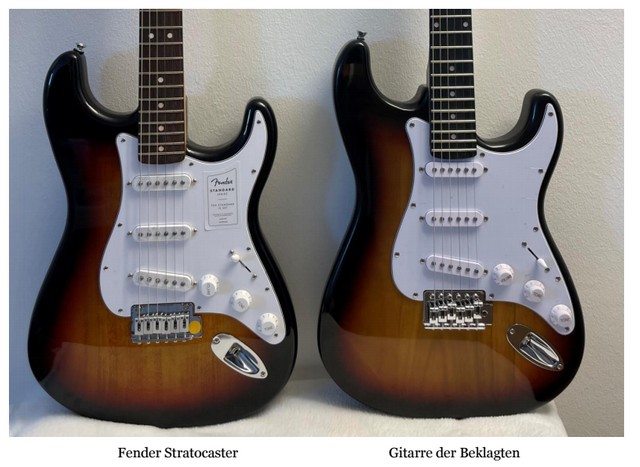
Photo of an original Stratocaster and the product marketed by the defendant (from the opinion of the Landgericht Düsseldorf of 22 December 2025 (case no. 14c O 64/25))
In the Stratocaster case, the Fender Musical Instruments Corporation, holder of the copyright to the body of the Stratocaster guitar since 1985, sued a Chinese company distributing via the AliExpress platform a guitar that was nearly an exact copy of the Stratocaster. The court awarded copyright protection to the Stratocaster body after making a detailed analysis of specific elements of the design and discussing their form within the context of the author’s creative choices (asymmetry and a lack of sharp edges—softly rounded shapes evoking anthropomorphic associations). The court found that such a futuristic, elegant and timeless design had no peers under the state of technology existing in 1954, and clearly reflected the personality of the designer.
In the test of infringement, the Düsseldorf court synthesised the existing case law from the German Federal Court of Justice with the new requirements announced by the Court of Justice of the European Union. In earlier cases, the BGH had often applied the “overall impression” test, holding that there was no infringement if the overall impression of the new work differed from the overall impression of the earlier work to such a degree that the creative elements of the earlier work were no longer recognisable. In Mio and konektra, the Court of Justice expressly rejected overall impression as a criterion for copyright infringement, holding that what was decisive was only whether the creative elements of the protected work were reproduced in a recognisable manner. But to some extent the Düsseldorf court combined these two approaches, reasoning that in the case of utilitarian objects, the creative choices are often manifest in the combination of elements, and thus, “in these constellations, the general picture of these elements, on which the Federal Court of Justice has so far based the overall impression, will probably retain its relevance.”
Practical consequences
The judgment by the Court of Justice in the Mio and konektra joined cases establishes a touchstone for assessing simultaneous protection of a design under copyright law and the law of industrial designs. The court clearly distinguished between the two protective regimes, pointing out that the law of industrial designs protects the external character of a product intended for mass production, while copyright protection can be awarded to designs only when they meet the criteria for being regarded as a “work,” i.e. the result of free, creative choices by the author reflecting his or her personality.
This ruling also underlines how important it is to document the design process (sketches, prototypes, aims), so that it can be shown that despite technical and functional limitations, the designer nonetheless exercised real creative freedom.
The ruling also indicates that in disputes over infringement of copyright to a design, it is not enough to show an overall visual similarity. It is necessary to identify and show which specific creative elements were reproduced.
Although the case law of the Court of Justice is intended to harmonise the interpretation of EU law, the practice in the member states to date in assessing the criterion of originality with respect to utilitarian objects has led to varying conclusions. This can be seen for example in recent rulings on footwear designs. In Germany, in a ruling dated 20 February 2025 the BGH denied copyright protection to Birkenstock sandals, finding that their design was largely driven by technical considerations, and the available freedom of choice was not exercised creatively. Meanwhile, in its judgment of 9 August 2024, the Danish Maritime and Commercial Court held in Ganni v Steve Madden that a certain juxtaposition of design elements in Ganni’s Buckle Ballerina shoe constituted an expression of the designer’s own creative choices (the ruling was upheld on appeal in 2025).
The Stratocaster case may suggest that the judgment by the Court of Justice in Mio and konektra has sparked a more favourable interpretation of the criterion of originality with respect to designs—at least in the practice of the German courts. The significance of that ruling for the further development of the case law in the Polish courts remains an open question.
Aleksandra Wrońska-Szymkowiak, attorney-at-law, Intellectual Property practice, Wardyński & Partners